Key Takeaways
- Start by confirming the pipe diameter to ensure the pipe centering clamp fits correctly.
- Consider the wall thickness for better handling and joint preparation during welding.
- Evaluate the clamp construction and duty class to match it with your project requirements.
- Look for a pipe centering clamp that allows easy adjustment across different pipe sizes.
- Assess grip and stability to maintain accurate positioning during the welding process.
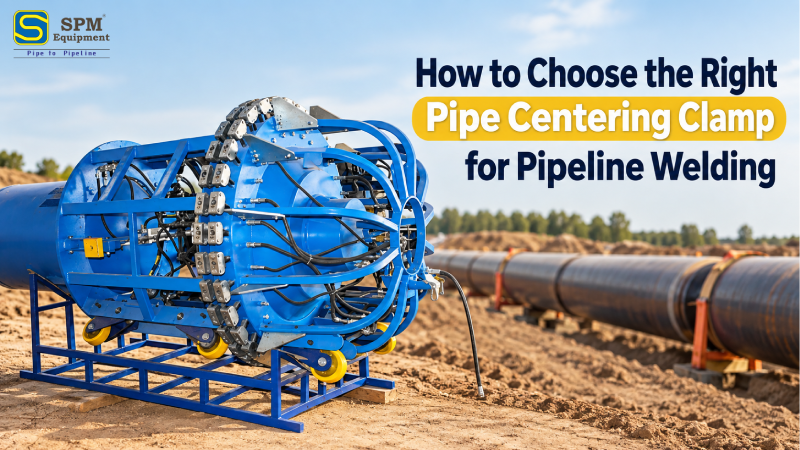
SPM Equipment is a leading manufacturer of PIPE CENTERING CLAMP for accurate pipe alignment during pipeline welding and fabrication.
Pipe alignment is one of the most important parts of preparing a pipeline joint for welding. A suitable centering clamp helps hold adjoining pipe sections in the required position, supports consistent fit-up, and reduces unnecessary adjustment at the welding point. For contractors and procurement teams, choosing the correct clamp should be based on actual pipe dimensions, operating conditions, and the welding workflow rather than selecting a general-purpose tool.
Why the Right Pipe Centering Clamp Matters
Pipeline welding requires the pipe ends to remain correctly positioned while the joint is prepared and welded. Poor alignment can make fit-up more difficult and may increase the amount of adjustment required by the welding team.
The right PIPE CENTERING CLAMP provides a stable grip and supports accurate centering before welding begins. This makes it particularly useful for pipeline construction, fabrication, repair, and maintenance work where repeatable pipe positioning is important.
1. Start With the Pipe Diameter
Pipe diameter should be one of the first details checked before selecting a clamp. A clamp must be suitable for the pipe size being handled and capable of maintaining the required contact around the pipe.
If the clamp does not match the pipe diameter correctly, achieving consistent positioning can become more difficult. Procurement teams should therefore provide the exact pipe size when requesting equipment.
For project-specific selection, SPM Equipment asks buyers to provide pipe size along with other project information so the appropriate equipment can be recommended.
2. Consider the Pipe Wall Thickness
Wall thickness is another important selection factor, particularly in oil and gas pipeline projects where pipe specifications can vary between applications.
The clamp selection should be made with the complete pipe specification in mind rather than diameter alone. Wall thickness can influence handling requirements, joint preparation, and the overall fit-up process.
When discussing your requirement with a manufacturer, provide both pipe diameter and wall thickness. This gives the technical team better information for recommending a suitable configuration.
3. Check the Clamp Construction and Duty Class
Industrial pipeline work requires equipment designed for demanding working conditions. Buyers should review the clamp material, construction, and intended duty before finalizing their requirement.
The pipe centering clamp offered by SPM Equipment is specified as a mild-steel welding clamp with a heavy-duty classification. The product is designed for oil and gas pipeline applications and has a round configuration.
For B2B buyers, these basic specifications provide a useful starting point when matching the clamp with the intended project environment.
4. Look for Easy Adjustment
Pipeline projects can involve different pipe sizes and fabrication requirements. A clamp that allows practical adjustment can reduce unnecessary setup work when positioning pipes before welding.
The PIPE CENTERING CLAMP is designed for adjustment across different pipe sizes and materials. An easy adjustment mechanism can help welding crews position the clamp correctly without making the fit-up process unnecessarily complicated.
The main objective should be accurate centering combined with practical operation at the welding location.
5. Evaluate Grip and Stability During Fit-Up
Once two pipe sections have been positioned, the clamp should hold them securely while the welding team completes the required preparation and welding work.
A stable grip helps prevent unwanted movement during fit-up. This is particularly important on pipeline construction sites where equipment must support repeatable operations across multiple joints.
Buyers should consider how the clamp will be positioned, adjusted, handled, and released during the actual welding sequence rather than evaluating it only by basic dimensions.
6. Match the Clamp to the Welding Application
Not every welding operation has identical requirements. Pipeline construction, maintenance, fabrication, and field welding can involve different working conditions.
Before selecting a clamp, define the actual application clearly. Consider whether the equipment will be used regularly on one pipe size or across different pipe diameters and materials.
For oil and gas pipeline work, SPM Equipment offers its WPC model as a heavy-duty welding clamp designed for pipe centering applications.
7. Consider Site Conditions and Project Location
Equipment selection should also reflect where and how the clamp will be used. Field pipeline construction can have different handling requirements from workshop fabrication.
Project location is therefore useful information when discussing equipment requirements. Buyers planning pipeline projects in Qatar, Kazakhstan, Libya, Thailand, Singapore, or other international markets should communicate the location together with pipe specifications and operating requirements.
This helps create a clearer technical discussion before equipment selection.
Buyer Checklist Before Selecting a Clamp
Before sending an enquiry for a PIPE CENTERING CLAMP, verify the basic project information your supplier will need:
- Confirm the required pipe diameter.
- Provide the pipe wall thickness.
- Identify the pipe material being welded.
- Explain the welding or fabrication application.
- Confirm whether one or multiple pipe sizes will be handled.
- Share the project or delivery location.
- Discuss any project-specific operating requirements.
Providing this information early can make equipment selection more straightforward for both the buyer and the technical team.
Common Mistakes to Avoid When Selecting a Pipe Centering Clamp
Some purchasing decisions become difficult because the equipment requirement is not clearly defined at the enquiry stage. Buyers should avoid:
- Selecting a clamp based only on a general pipe-size estimate.
- Ignoring wall thickness when sharing pipe specifications.
- Choosing equipment without considering actual welding conditions.
- Failing to discuss the range of pipe sizes used on the project.
- Treating workshop and field operating requirements as identical.
- Sending an enquiry without complete project information.
A well-defined requirement helps the manufacturer understand the application and recommend equipment suited to the intended work.
Why Choose Us
SPM Equipment manufactures pipeline construction equipment for onshore and offshore project requirements and has been serving the industry since 2016. Our pipe centering clamp is designed for accurate alignment, easy adjustment, stable pipe holding, and heavy-duty pipeline applications. We work with pipeline contractors, engineering companies, fabricators, and industrial buyers requiring equipment matched to their project specifications. Buyers can share pipe size, wall thickness, and project location with our team for suitable equipment guidance.
Conclusion
Choosing the correct PIPE CENTERING CLAMP starts with understanding the actual pipeline welding requirement. Pipe diameter, wall thickness, material, adjustment needs, grip stability, application, and project conditions should all be considered before equipment selection. A correctly selected clamp supports accurate pipe positioning and makes the welding fit-up process more practical for field and fabrication teams. SPM Equipment works with B2B buyers and pipeline contractors to understand these project requirements and recommend suitable pipeline equipment based on the technical information provided.
Looking for a reliable pipe centering clamp for your upcoming pipeline welding project? Share your pipe size, wall thickness, application, and project location with our sales team to discuss the right equipment for your requirement.
Call: +91 957 477 0022
Or Email: spmequipment@gmail.com
Send your project requirement today and talk with our team about the right pipe centering solution for your pipeline welding application.
Frequently Asked Questions
When selecting a pipe centering clamp, consider the pipe diameter, wall thickness, material being welded, and the specific welding application. Additionally, evaluate the clamp's construction, ease of adjustment, grip stability during fit-up, and site conditions.
The pipe diameter is crucial because a clamp must fit the specific pipe size to ensure accurate positioning. If the clamp is not appropriately sized, achieving consistent alignment can be challenging, intensifying the difficulty of the fit-up process.
Wall thickness influences handling requirements and joint preparation, especially in varied applications like oil and gas projects. Providing both the diameter and wall thickness allows manufacturers to recommend a suitable clamp configuration.
Buyers should avoid selecting a clamp based solely on a general pipe size estimate, ignoring wall thickness, and failing to discuss varying pipe sizes for the project. Clear and specific project information helps manufacturers recommend the right equipment.
To ensure proper grip and stability, evaluate how the clamp is positioned, adjusted, handled, and released during welding. The clamp should securely hold the pipe sections in place, preventing unwanted movement during the fit-up process.